service
=========



 Add custom services to your Linux system.
Example Playbook
----------------
This example is taken from `molecule/resources/playbook.yml` and is tested on each push, pull request and release.
```yaml
---
- name: Converge
hosts: all
become: yes
gather_facts: yes
vars:
_service_test_command:
default: /usr/bin/sleep
Alpine: /bin/sleep
service_test_command: "{{ _service_test_command[ansible_os_family] | default(_service_test_command['default']) }}"
service_list:
- name: simple-service
description: Simple Service
start_command: "{{ service_test_command }} 3600"
- name: forking-service
description: Forking Service
type: forking
start_command: "{{ service_test_command }} 7200 &"
- name: specific-stop-service
description: Specific Stop Service
start_command: "{{ service_test_command }} 1440"
stop_command: killall -f "sleep 1440"
- name: specific-user-group-service
description: Specific User Group Service
start_command: "{{ service_test_command }} 28800"
user_name: root
group_name: root
- name: specific-workingdirectory-service
description: Specific WorkingDirectory Service
start_command: "{{ service_test_command }} 57600"
working_directory: /tmp
- name: specific-pattern-service
description: Specific Status Pattern Service
start_command: "{{ service_test_command }} 115200"
status_pattern: 115200
roles:
- robertdebock.service
```
The machine you are running this on, may need to be prepared, I use this playbook to ensure everything is in place to let the role work.
```yaml
---
- name: Prepare
hosts: all
gather_facts: no
become: yes
serial: 30%
roles:
- role: robertdebock.bootstrap
```
After running this role, this playbook runs to verify that everything works, this may be a good example how you can use this role.
```yaml
---
- name: Verify
hosts: all
become: yes
gather_facts: yes
vars:
service_list:
- name: simple-service
tasks:
- name: start simple-service
service:
name: simple-service
state: started
- name: stop simple-service
service:
name: simple-service
state: stopped
- name: restart simple-service
service:
name: simple-service
state: restarted
```
Also see a [full explanation and example](https://robertdebock.nl/how-to-use-these-roles.html) on how to use these roles.
Role Variables
--------------
These variables are set in `defaults/main.yml`:
```yaml
---
# defaults file for service
# status_list can contain a list of services to add to the system.
# The mandatory items for each item are:
# - name: The (short) name of the service, i.e. "tomcat".
# - description: A bit longer name, i.e. "Tomcat application server".
# - start_command: The command to start the daemon,
# i.e. "/usr/local/bin/java -jar some.jar"
# The optional items are:
# - stop_command: By default the program that is started is found and stopped.
# in case a running program is renamed or expanded (including a path) during
# startup, you can specify a custom stop command here, i.e. "pkill foo"
# - status_pattern: What program (or pattern) to look for when finding the
# status of a program, i.e. "artifactory".
# - type: How the program starts; "simple" or "forking". Simple means the
# program runs on the foreground, i.e. "nc -l 1234". Forking means the
# program itself forks, i.e. "nc -l 12345 &"
# - working_directory: The directory to cd into before starting the service.
```
Requirements
------------
- Access to a repository containing packages, likely on the internet.
- A recent version of Ansible. (Tests run on the current, previous and next release of Ansible.)
The following roles can be installed to ensure all requirements are met, using `ansible-galaxy install -r requirements.yml`:
```yaml
---
- robertdebock.bootstrap
```
Context
-------
This role is a part of many compatible roles. Have a look at [the documentation of these roles](https://robertdebock.nl/) for further information.
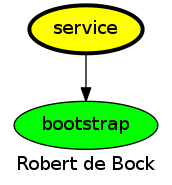
Here is an overview of related roles:
Compatibility
-------------
This role has been tested on these [container images](https://hub.docker.com/):
|container|tag|allow_failures|
|---------|---|--------------|
|amazonlinux|1|no|
|amazonlinux|latest|no|
|alpine|latest|no|
|alpine|edge|yes|
|debian|unstable|yes|
|debian|latest|no|
|centos|7|no|
|redhat|7|no|
|centos|latest|no|
|redhat|latest|no|
|fedora|latest|no|
|fedora|rawhide|yes|
|opensuse|latest|no|
|ubuntu|latest|no|
This role has been tested on these Ansible versions:
- ansible>=2.8, <2.9
- ansible>=2.9
- git+https://github.com/ansible/ansible.git@devel
Testing
-------
[Unit tests](https://travis-ci.org/robertdebock/ansible-role-service) are done on every commit, pull request, release and periodically.
If you find issues, please register them in [GitHub](https://github.com/robertdebock/ansible-role-service/issues)
Testing is done using [Tox](https://tox.readthedocs.io/en/latest/) and [Molecule](https://github.com/ansible/molecule):
[Tox](https://tox.readthedocs.io/en/latest/) tests multiple ansible versions.
[Molecule](https://github.com/ansible/molecule) tests multiple distributions.
To test using the defaults (any installed ansible version, namespace: `robertdebock`, image: `fedora`, tag: `latest`):
```
molecule test
# Or select a specific image:
image=ubuntu molecule test
# Or select a specific image and a specific tag:
image="debian" tag="stable" tox
```
Or you can test multiple versions of Ansible, and select images:
Tox allows multiple versions of Ansible to be tested. To run the default (namespace: `robertdebock`, image: `fedora`, tag: `latest`) tests:
```
tox
# To run CentOS (namespace: `robertdebock`, tag: `latest`)
image="centos" tox
# Or customize more:
image="debian" tag="stable" tox
```
Modules
-------
This role uses the following modules:
```yaml
---
- meta
- package
- setup
- systemd
- template
```
License
-------
Apache-2.0
Author Information
------------------
[Robert de Bock](https://robertdebock.nl/)
Add custom services to your Linux system.
Example Playbook
----------------
This example is taken from `molecule/resources/playbook.yml` and is tested on each push, pull request and release.
```yaml
---
- name: Converge
hosts: all
become: yes
gather_facts: yes
vars:
_service_test_command:
default: /usr/bin/sleep
Alpine: /bin/sleep
service_test_command: "{{ _service_test_command[ansible_os_family] | default(_service_test_command['default']) }}"
service_list:
- name: simple-service
description: Simple Service
start_command: "{{ service_test_command }} 3600"
- name: forking-service
description: Forking Service
type: forking
start_command: "{{ service_test_command }} 7200 &"
- name: specific-stop-service
description: Specific Stop Service
start_command: "{{ service_test_command }} 1440"
stop_command: killall -f "sleep 1440"
- name: specific-user-group-service
description: Specific User Group Service
start_command: "{{ service_test_command }} 28800"
user_name: root
group_name: root
- name: specific-workingdirectory-service
description: Specific WorkingDirectory Service
start_command: "{{ service_test_command }} 57600"
working_directory: /tmp
- name: specific-pattern-service
description: Specific Status Pattern Service
start_command: "{{ service_test_command }} 115200"
status_pattern: 115200
roles:
- robertdebock.service
```
The machine you are running this on, may need to be prepared, I use this playbook to ensure everything is in place to let the role work.
```yaml
---
- name: Prepare
hosts: all
gather_facts: no
become: yes
serial: 30%
roles:
- role: robertdebock.bootstrap
```
After running this role, this playbook runs to verify that everything works, this may be a good example how you can use this role.
```yaml
---
- name: Verify
hosts: all
become: yes
gather_facts: yes
vars:
service_list:
- name: simple-service
tasks:
- name: start simple-service
service:
name: simple-service
state: started
- name: stop simple-service
service:
name: simple-service
state: stopped
- name: restart simple-service
service:
name: simple-service
state: restarted
```
Also see a [full explanation and example](https://robertdebock.nl/how-to-use-these-roles.html) on how to use these roles.
Role Variables
--------------
These variables are set in `defaults/main.yml`:
```yaml
---
# defaults file for service
# status_list can contain a list of services to add to the system.
# The mandatory items for each item are:
# - name: The (short) name of the service, i.e. "tomcat".
# - description: A bit longer name, i.e. "Tomcat application server".
# - start_command: The command to start the daemon,
# i.e. "/usr/local/bin/java -jar some.jar"
# The optional items are:
# - stop_command: By default the program that is started is found and stopped.
# in case a running program is renamed or expanded (including a path) during
# startup, you can specify a custom stop command here, i.e. "pkill foo"
# - status_pattern: What program (or pattern) to look for when finding the
# status of a program, i.e. "artifactory".
# - type: How the program starts; "simple" or "forking". Simple means the
# program runs on the foreground, i.e. "nc -l 1234". Forking means the
# program itself forks, i.e. "nc -l 12345 &"
# - working_directory: The directory to cd into before starting the service.
```
Requirements
------------
- Access to a repository containing packages, likely on the internet.
- A recent version of Ansible. (Tests run on the current, previous and next release of Ansible.)
The following roles can be installed to ensure all requirements are met, using `ansible-galaxy install -r requirements.yml`:
```yaml
---
- robertdebock.bootstrap
```
Context
-------
This role is a part of many compatible roles. Have a look at [the documentation of these roles](https://robertdebock.nl/) for further information.
Here is an overview of related roles:

Compatibility
-------------
This role has been tested on these [container images](https://hub.docker.com/):
|container|tag|allow_failures|
|---------|---|--------------|
|amazonlinux|1|no|
|amazonlinux|latest|no|
|alpine|latest|no|
|alpine|edge|yes|
|debian|unstable|yes|
|debian|latest|no|
|centos|7|no|
|redhat|7|no|
|centos|latest|no|
|redhat|latest|no|
|fedora|latest|no|
|fedora|rawhide|yes|
|opensuse|latest|no|
|ubuntu|latest|no|
This role has been tested on these Ansible versions:
- ansible>=2.8, <2.9
- ansible>=2.9
- git+https://github.com/ansible/ansible.git@devel
Testing
-------
[Unit tests](https://travis-ci.org/robertdebock/ansible-role-service) are done on every commit, pull request, release and periodically.
If you find issues, please register them in [GitHub](https://github.com/robertdebock/ansible-role-service/issues)
Testing is done using [Tox](https://tox.readthedocs.io/en/latest/) and [Molecule](https://github.com/ansible/molecule):
[Tox](https://tox.readthedocs.io/en/latest/) tests multiple ansible versions.
[Molecule](https://github.com/ansible/molecule) tests multiple distributions.
To test using the defaults (any installed ansible version, namespace: `robertdebock`, image: `fedora`, tag: `latest`):
```
molecule test
# Or select a specific image:
image=ubuntu molecule test
# Or select a specific image and a specific tag:
image="debian" tag="stable" tox
```
Or you can test multiple versions of Ansible, and select images:
Tox allows multiple versions of Ansible to be tested. To run the default (namespace: `robertdebock`, image: `fedora`, tag: `latest`) tests:
```
tox
# To run CentOS (namespace: `robertdebock`, tag: `latest`)
image="centos" tox
# Or customize more:
image="debian" tag="stable" tox
```
Modules
-------
This role uses the following modules:
```yaml
---
- meta
- package
- setup
- systemd
- template
```
License
-------
Apache-2.0
Author Information
------------------
[Robert de Bock](https://robertdebock.nl/)